Brand OSMO

German wood oils and waxes
OSMO is a German manufacturer of wood oils, waxes and woodstains for interior and exterior use, proven over decades. The finishes are not built on a synthetic film but on natural plant oils and hard waxes - so they do not flake, and damage is repaired locally without sanding the whole surface back.
1878.
And 60 countries.
Osmo is a German brand of wood oils, waxes, paints and woodstains with more than 140 years behind it. It makes the finishes in its own plants in Warendorf and Münster and ships them to over 60 countries.
Natural oils and hard waxes protect the wood, bring out its grain and allow a local repair without sanding the whole surface.
A further advantage of the brand: Natural Oil Woodstain and Country Colour can both be mixed in RAL Classic and NCS colours.
What makes OSMO different from an ordinary paint manufacturer
Four things set this brand apart, and you feel all four in the finished coat:
Wood and finish from one house
- OSMO is not only a paint works. The company planes and processes timber and develops and manufactures the finishes, both in its own plants.
- So the formulations did not come out of a laboratory cut off from the material. The developers know how spruce, oak or larch behave because the same species are being worked in the next hall.
- Products are put through long-term testing in real climatic conditions in Warendorf and Münster.
Fewer steps in the work
- Polyx-Oil goes on without a primer and without sanding between coats. Two thin coats are enough - fewer steps mean fewer places to get the result wrong.
- Decking-Oil, UV-Protection-Oil and Country Colour need no primer either. On new softwood outdoors, though, the manufacturer recommends an impregnation against blue stain and rot.
- To refresh a surface you clean it and apply one coat; the old finish does not have to be sanded off. For small scratches OSMO has a repair paste. With lacquer, a peeling film has to be removed completely.
Sustainability and healthy living
- OSMO supports sustainable forestry and has met the FSC® and PEFC standards since 2005.
- The finishes do not seal the wood; they let it breathe and regulate moisture. What is good for the wood is good for the air in the room.
- The ingredient list of every product is published as a full declaration, so you can check the quality yourself.
High solids content
- The finishes carry a high proportion of solids. One litre of Polyx-Oil covers roughly 24 m² in a single coat, one litre of Country Colour roughly 26 m².
- The tin costs more, but it goes further per square metre, and on bare wood the manufacturer specifies two coats.


Polyx-Oil: why it works differently from lacquer
Lacquer forms a sealed film on the wood. While it is whole, it holds. Once it is broken, moisture gets underneath and the film peels away in patches. Polyx-Oil works the other way round - it seals nothing off.
How does it work?
The oil penetrates the pores of the wood and protects it from inside; the hard waxes form a breathable layer on the surface that protects it from outside. The result is a microporous surface:
- The wood can breathe and regulate moisture, so it moves less
- The finish does not crack, flake or blister
- The binder is made of natural plant oils - sunflower, soybean, thistle and linseed
- Surface durability comes from carnauba and candelilla wax, the hardest natural waxes
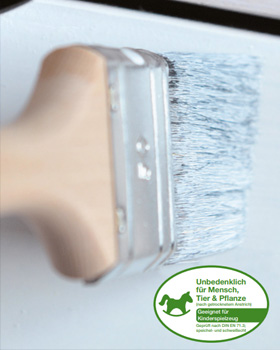
That is exactly why what the finish is made of matters. Polyx-Oil is built on natural oils and waxes that are also approved for the food industry. The manufacturer states it as suitable for food contact under EN 1186 and for children's toys under DIN 53160 and DIN EN 71-3. It contains no health-harmful biocides, preservatives or aromatic substances, and it deliberately avoids turpentine oils, among the most common triggers of allergies during painting. OSMO publishes the composition of every product as a full declaration on its website.
Picks from the OSMO range at Zrubko


OSMO outdoors: deck, facade, fence
Outdoors is a different discipline from indoors. UV radiation, the moisture content of the wood and whether you walk on the surface all decide the outcome. Which is why a deck takes a different product from a facade.
How will you use OSMO products at your place?
- Decking-Oil for horizontal surfaces that are walked on. Check it at least once a year and recoat as needed.
- UV-Protection-Oil Extra for vertical surfaces: facades, doors, shutters, fences, pergolas and garden shelters. It protects against UV in the clear version too. The manufacturer specifies two coats.
- Natural Oil Woodstain for facades, fences and garden furniture. It contains biocides and does not belong indoors.
- Country Colour where you want an opaque and especially durable finish. It covers the grain of the wood.
With ordinary woodstains and oils it is the pigment that absorbs UV radiation, so clear and pale transparent colours protect against the sun only to a limited degree. If you want to keep the original colour of the wood and have UV protection at the same time, just any clear finish will not do - that is what UV-Protection-Oil Extra is for, developed by the manufacturer precisely as a clear UV protection for outdoor use.

A colour exactly to your requirements?
Woodstains in RAL Classic and NCS colours, mixed to order at Zrubko
Match a fence, facade cladding or garden shelter to the colour of your windows or gate by an exact code, not by eye.
We mix Natural Oil Woodstain, Country Colour and Wood Wax Finish, from 2.5 litres per colour. A woodstain is transparent, so a test coat on your own wood is not a formality - bring us a piece and we will finish it.
contact us →Frequently asked questions about OSMO
What is the difference between OSMO oil and lacquer?
The oil soaks into the wood and the wax forms a breathable layer on the surface. The result is a microporous finish that does not crack or flake.
Lacquer forms a sealed film. While the film is intact it holds. Once it is broken, moisture gets underneath and the film peels away in patches. An oiled surface is renewed by cleaning it and recoating without sanding; a lacquered one has to be sanded back completely.
How much oil do I need per square metre?
Polyx-Oil and Decking-Oil both cover roughly 24 m² per litre in one coat, so about 12 m² per litre over two coats. UV-Protection-Oil Extra covers roughly 18 m² per litre.
Those figures are for a smooth surface. On grooved decking boards and rough-sawn timber expect considerably less.
Do I need a primer or sanding between coats before oiling?
No primer. On bare wood the manufacturer specifies two thin coats; for a refresh one coat on a cleaned surface is normally enough, without sanding.
Drying time between coats depends on the product:
- Polyx-Oil Original - approximately 8 to 10 hours
- Natural Oil Woodstain - approximately 4 to 6 hours
- Decking-Oil - approximately 12 hours
- UV-Protection-Oil Extra - approximately 12 hours
These apply under normal climate, meaning 20 to 23 °C and 50 to 65 % relative humidity, with good ventilation. Lower temperature or higher humidity extends drying considerably. The wood must be clean, dry and free of frost.
Polyx-Oil needs no sanding between coats. On new softwood outdoors the manufacturer does recommend an impregnation against blue stain and rot before the finish - not for adhesion, but for biological protection.
When can I oil a new deck?
The wood has to weather before the first coat, otherwise the finish has nowhere to soak in and will not hold evenly. Waiting times:
- Resinous timber, meaning larch and Douglas fir - at least 6 weeks
- Freshly pressure-treated timber - at least 6 months
- Massaranduba, bangkirai, garapa - at least 3 months
Moisture content must be no more than 18 % for Decking-Oil and no more than 20 % for woodstains and UV-Protection-Oil. After rain, let the wood dry for two to three days.
Is a clear oil enough for a sunny deck?
With ordinary woodstains and oils, no. Pigment is what absorbs UV radiation, so clear and pale colours protect against the sun only to a limited degree.
If you want to keep the original colour of the wood and still have UV protection, you need a finish developed for exactly that - UV-Protection-Oil Extra. It works in the clear version too.
How do I check a colour before ordering?
With a sample sachet. One sachet holds 5 ml of finish, enough for a sample of roughly 20 × 30 cm in two coats. How to use it:
- Knead the sachet thoroughly before opening so the contents mix
- Apply half of it thinly along the grain with a cotton cloth or a thin, firm brush
- Tape the opened sachet shut with the other half still inside
- Let it dry for as long as the product needs - 8 to 10 hours for Polyx-Oil, roughly 12 hours for Decking-Oil and UV-Protection-Oil - then apply the second half
Or bring us a piece of your own wood and we will apply the colour to it. With woodstains mixed to order this is the only way to see the real result before you commit to 2.5 litres.
Can OSMO be mixed to match the colour of my facade?
Yes. We mix three ranges to order:
- Natural Oil Woodstain - exterior, transparent
- Country Colour - exterior and interior, opaque
- Wood Wax Finish - interior
186 RAL Classic colours and 1,950 NCS colours are available, from 2.5 litres per colour.
Colours can be combined, but only within one range - Country Colour cannot be mixed with the oil woodstain.
Because a woodstain is transparent and the substrate shows through, the timber species affects the result. So always do a test coat on the same wood you are going to finish.
Are OSMO finishes safe for children?
The manufacturer states that once dry, Polyx-Oil is safe for people, animals and plants, and declares it compliant with the following standards:
- EN 71-3 - suitable for children's toys
- DIN 53160 - resistant to saliva and perspiration
- DIN 68861-1A - resistant to common household liquids
Biocides have to be judged product by product, not brand-wide:
- Polyx-Oil and the decorative waxes - free of biocides, preservatives and aromatic substances
- UV-Protection-Oil Extra 420 - contains the biocide IPBC, labelled as film protection. That is exactly why it does not belong indoors, on children's play equipment or on table tops
- Country Colour in standard shades - biocide-free; the manufacturer only adds biocides on request
- Decking-Oil - biological protection is handled by a separate impregnation applied underneath the finish
If you need a clear UV finish without biocides, there is also UV-Protection-Oil 410 without film protection.
How long has OSMO been making wood finishes?
The company started in 1878 as a timber and building-materials merchant in Neheim in the Sauerland. Since 1900 its head office has been in Münster, where it built modern planing works in 1923. Bombing destroyed them in 1940 and the company rebuilt.
The turning point came in 1964 with the founding of the wood-finishes division. In 2002 the Cordes holding took the company over and timber processing moved to Warendorf. Development and production of the finishes have stayed in Münster to this day.
The name is an abbreviation: Ostermann & Scheiwe were the original owners, Monasterium is the Latin name for Münster.
What should OSMO oils be applied with?
With oils applied thinly, the result comes down to how much product the tool picks up and how evenly it spreads it. What gets used:
- Flat brush 25 to 100 mm for details, edges and smaller areas
- Floor brush 220 and 400 mm for floors
- Decking brush with a 150 mm head for smooth and profiled decking boards
- Microfibre roller for an even thin coat on smooth surfaces
- Microfibre application fleece for Polyx-Oil on larger areas
All of it fits the Quick Connect telescopic handle at 120-200 cm, so you do not have to work on your knees on a deck or floor.
Safety warning: rags soaked in oil can self-ignite. After work, let them dry out completely spread flat, or put them in a closed metal container.