
Do not forget the spacing between boards
Correct installation of decking boards
Every timber structure swells and shrinks as the weather changes – it is the nature of wood. If decking boards are installed incorrectly, they can swell, be damaged by moisture and crack. The screws are then put under heavy stress. That is why the Swedish industry association Svenskt Trä has issued new recommendations for building decks.
1. Spacing between boards
A new way of determining the spacing between boards: the spacing depends on the width of the boards and the type of wood they are made of.
2. Screw position in the decking board
Place the screw 30 mm from the long edge and 45 mm from the end of the board. Where boards are butt-jointed, use additional joists.
3. The screw head should be flush with the board surface.
Correct installation prevents water from collecting in the recesses and soaking into the wood.
4. Protecting the deck structure from moisture.
Make sure that the structural members are separated from the ground and from the deck foundations. If there is no waterproofing, use bitumen materials to protect the deck structure from damage.
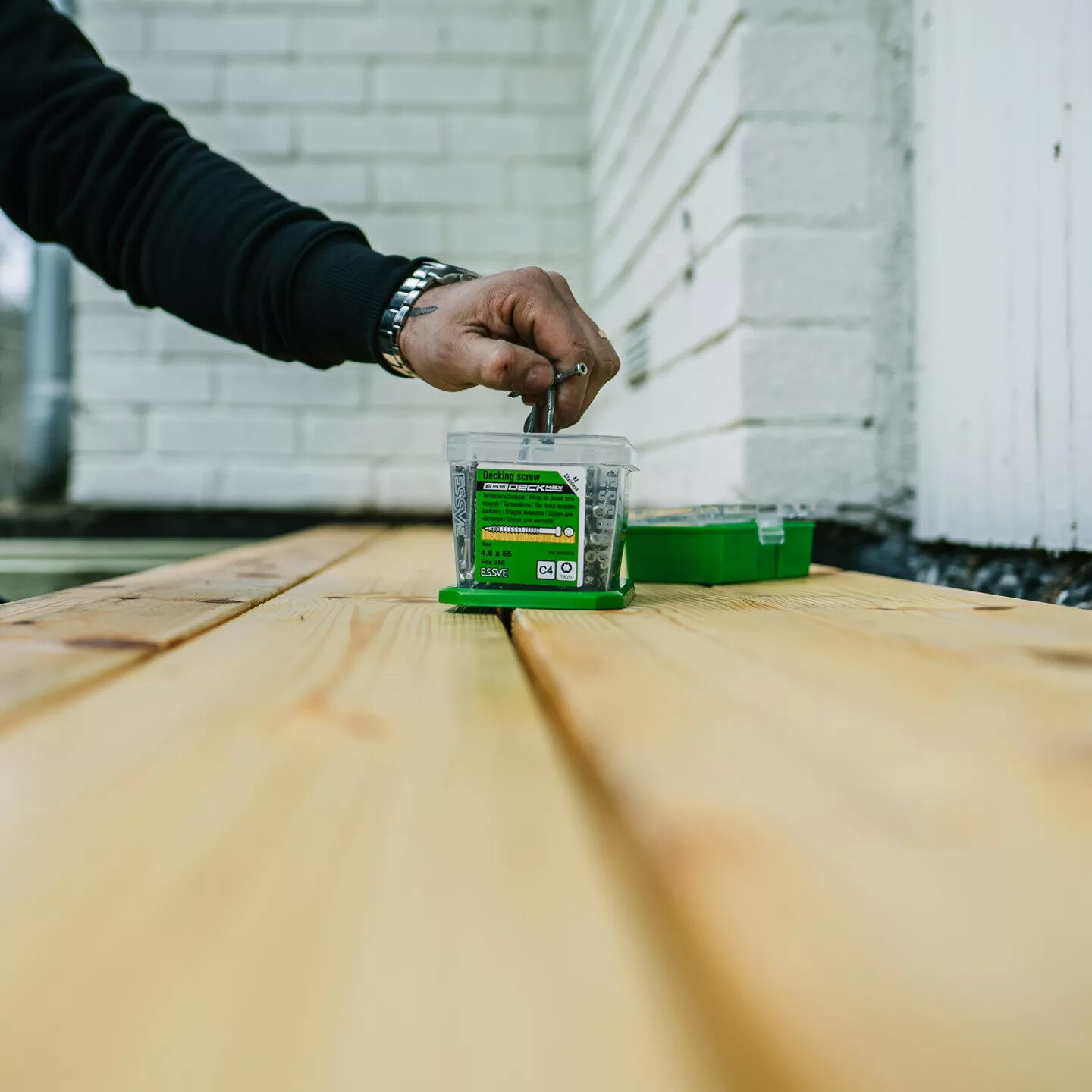
Video by the manufacturer ESSVE, without English subtitles.

We asked Swedish carpenter Tim Jaederfeldt, who has built more than 100 decks, how the recommendations work in practice.
Tim, why are these recommendations important?
“For years, rules circulated among contractors that did not always lead to correct installation of decking boards. It is good that there are now guidelines that show how to build a deck correctly.”
What do they cover, in short?
“Everything – from how to build a deck substructure that is well protected from moisture, through the right choice of screws, to the most important rule: never install boards without gaps. The recommendations clearly set the size of the gap according to the width of the boards and the type of wood they are made of.”
Why is the gap size so important?
“Until recently, the gap was always the same width, regardless of the width of the boards and the type of wood. Boards installed according to the guide, with the recommended spacing between adjacent edges, will be laid correctly whatever the humidity.”
You mentioned boards cracking. Which principles reduce this risk?
“Placing the screws 30 mm from the edge of the board and pre-drilling minimise the risk of cracking.”
How should boards be joined correctly?
“When building a deck, we should avoid cutting and joining boards along their length. If it cannot be avoided, use additional joists and place the screws 45 mm from the end of the board. This kind of installation significantly reduces the risk of cracks.”
How do you protect the deck substructure from moisture?
“The guide is clear about this. All structural members of the deck that are in contact with the ground, the foundations or the walls must be separated with bitumen damp-proofing.”
How should screws be driven?
“Always perpendicular, with the head flush with the board surface.”
How do you choose the right screws?
“There are clear instructions depending on the type of wood and where the deck is located, but my advice is: always choose stainless steel screws. They are corrosion-resistant and cope well with the stresses that arise in timber structures.”
And finally: which side of the board is the ‘right’ one?
“To help water run off the deck, it is important to lay the boards correctly. If possible, lay the board heart side up. A correctly laid board will curve slightly upwards over time, so water runs off the deck surface more easily.”
Recommended articles

Why stainless steel screws?
When should you choose screws made of stainless steel A2, and when acid-proof stainless steel A4?