
Thermally modified wood: what it is, how it is made and when it is worth using outdoors
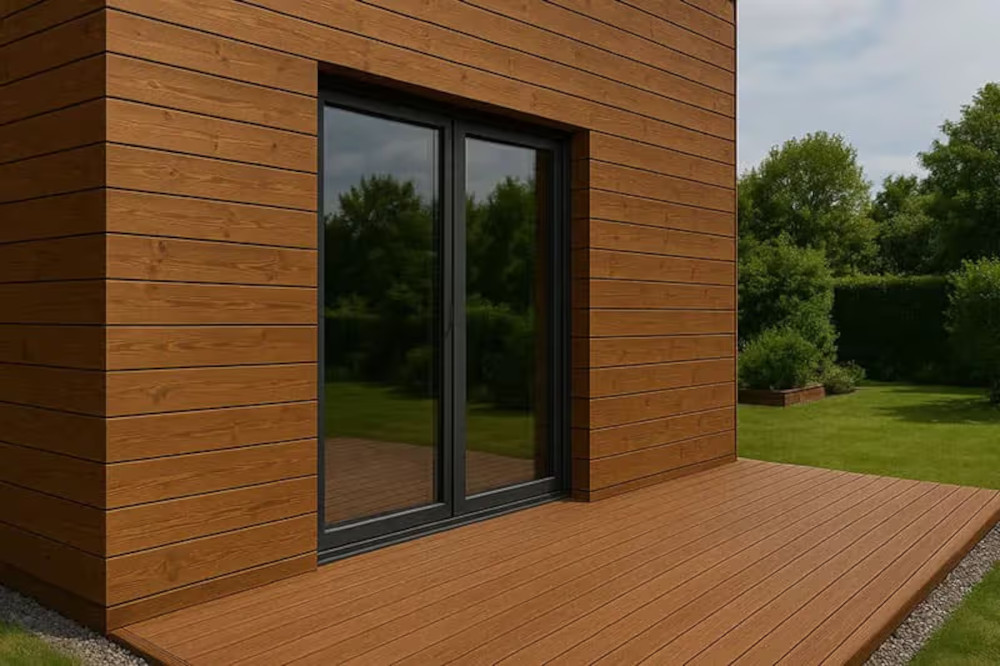
Thermally modified wood is made by heating wood to a temperature of 160 to 220 °C in a kiln without oxygen. It is neither a coating nor a chemical impregnation - the heat itself permanently changes the internal structure of the wood so that it loses its appeal to fungi and insects and stops "working" with moisture. The exact temperature range and duration of the process are defined in the ThermoWood Handbook, the technical handbook of the International ThermoWood Association.
If you are deciding between thermally modified wood, impregnated wood and exotic wood species for a deck or facade, the decision can be narrowed down to three questions:
- how long the material should last outdoors without much care
- how much you are willing to pay up front
- whether any part of the wood will ever bear a load.
Thermally modified wood answers the first two questions well, the third one less so - and that is its most frequently overlooked limitation. In this article we will help you understand the advantages of thermally modified wood, but we will also reveal its disadvantages.
At Zrubko, our philosophy is to help you choose the most suitable material in first-class quality and to be your partner in every project. Let's get started!
How is thermally modified wood made?
Thermally modified wood (also known as thermowood or heat-treated wood; the term used in English-language sources is thermally modified wood) is ordinary wood - most often pine, spruce, ash or beech. It has, however, then undergone controlled heat treatment.
Unlike impregnation, no chemical substance is added. The process changes only the wood itself: it breaks down part of the hemicelluloses, i.e. the sugars that fungi and wood-boring insects feed on, and reduces the wood's ability to bind water. This is a big advantage if you care about eco-friendly materials that are safe for health.
The high temperature changes the internal structure of the wood - above all the polysaccharides and hemicelluloses, which are the natural food of fungi and bacteria. As a result, the wood's susceptibility to biological damage is significantly reduced. The whole process also reduces the wood's ability to absorb water. The wood thus becomes more dimensionally stable, which means that it twists, cracks or swells less when the moisture level changes. Below we take a look at the treatment process by which thermally modified wood is made.
The heat treatment process
Production takes place in three phases, more than 30 hours in total:
- Drying and rapid heating - the temperature in the kiln quickly rises to approximately 100 °C to evaporate the remaining moisture from the wood.
- The heat treatment itself - the temperature gradually rises to the target 185 to 220 °C and is held at this level for 2 to 3 hours. Throughout the process there is steam in the kiln, which prevents the wood from burning and transfers the heat evenly to the whole cross-section.
- Cooling and stabilisation - the wood is gradually cooled and slightly moistened so that its moisture content settles at a level suitable for further processing.
The whole process is purely physical - no dyes, no preservatives. The darker shade of the wood is a by-product of the breakdown of sugars and lignin, not a surface finish.
Thermo-S vs Thermo-D classes
Most thermally modified wood on the market is produced in one of two classes. How do they differ? In the treatment temperature, and therefore also in the resulting properties of the finished material. The classification is set by the International ThermoWood Association. And we have summarised the differences clearly in the table below.
| Property | Thermo-S | Thermo-D |
|---|---|---|
| Treatment temperature | approx. 185 - 190 °C | approx. 210 - 220 °C |
| Main benefit | dimensional stability, finer appearance | biological durability, weather resistance |
| Colour | lighter, golden brown | darker, brown |
| Typical use | interiors, sheltered exterior, furniture | decks, facades, outdoor structures, saunas |
| Suitable for outdoor use without protection | limited | yes |
Even if some of the terms are unfamiliar, we have good news for you - for outdoor use in Slovakia - that is, most often thermally modified wood for decks and facade cladding - the Thermo-D class is almost always recommended. Thermo-S is better suited to interiors or covered, sheltered areas. Our range offers exactly this more durable wood.
Properties of thermally modified wood - what the treatment changes compared with the raw material
Heat treatment results in wood that keeps its aesthetic qualities but gains new properties:
- Resistance to mould and insects - thanks to the breakdown of hemicelluloses, thermally modified wood is no longer a suitable environment for pests.
- Dimensional stability - minimal movement with moisture means that it keeps its shape over the long term even in unfavourable conditions.
- Long service life - thermally modified wood is more resistant to the weather, which extends its usability outdoors.
- Eco-friendly treatment - thermal modification is a purely physical process without chemical impregnation.
- Natural aesthetics - the wood gains an attractive darker shade that runs through the whole cross-section, not just the surface.
Dimensional stability and moisture of thermally modified wood
Ordinary wood swells when damp and shrinks when dry - it is precisely this movement that causes cracks, cupping of boards and loosening of joints. Heat treatment lowers the equilibrium moisture content of the wood and significantly limits its ability to absorb water, so thermally modified wood moves considerably less than untreated wood of the same species.
Resistance of thermally modified wood to rot and insects
In Europe, the biological durability of wood is assessed according to EN 350 on a five-point scale, where class 1 means very durable wood and class 5 non-durable. Untreated pine or spruce falls into class 3 to 4.
After heat treatment at a high temperature (class Thermo-D), the wood typically moves up to class 1 to 2 - to a level comparable with naturally durable tropical species, according to the overview of durability classes compiled by the British Woodworking Federation. Fungi and insects need the sugars from hemicelluloses to break down wood, and it is precisely these that largely break down at high temperatures. Enough technicalities, let's move on to the visual and sensory properties.
Colour, scent, appearance
Thermally modified wood has an even brown shade across the whole cross-section, not just on the surface - when cutting or drilling you will see the same colour as on the outside. The scent is slightly "toasted", reminiscent of baked goods or smoke, and fades over time. The grain of the species is preserved, only in a darker, more uniform tone.
Disadvantages of thermally modified wood
As we promised at the beginning, we will also look at the disadvantages and we will not hide them. After all, our goal is to help you find your way among materials and choose the most suitable one for your needs and ideas.
Heat treatment has its price, not just benefits. The breakdown of hemicelluloses takes away part of the wood's bending strength and toughness. According to the Center for Forest Products Business thermally modified wood is mechanically weaker than untreated wood of the same species. That is why it is not recommended for load-bearing structural elements.
Bending strength can drop by approximately 20 % or more, depending on the species and the intensity of the treatment. The wood is also more brittle - when screwing close to the edge of a board, we recommend pre-drilling a hole, otherwise there is a risk of splitting. Like any untreated wood outdoors, thermally modified wood also turns grey over time under UV radiation unless you protect it with wood oil.
Comparison of thermally modified wood vs. ordinary wood vs. impregnated wood
| Criterion | Thermally modified wood | Ordinary wood | Impregnated wood |
|---|---|---|---|
| Outdoor durability | 25 - 30 years (Thermo-D) | 3 - 8 years without treatment | 15 - 25 years |
| Purchase price | higher | lowest | medium |
| Maintenance requirements | oiling 1 - 2x every 1 - 2 years | regular coating, risk of rot | occasional coating |
| Use of chemicals | none | none | yes (pressure impregnation) |
| Dimensional stability | high | low | medium |
| Suitable for load-bearing elements | no | yes (depending on species) | yes |
The difference between thermally modified wood and ordinary wood shows mainly in the long term. Ordinary wood is the cheapest to buy, but outdoors without regular impregnation it loses its properties within a few years.
Impregnated wood achieves solid durability thanks to chemical substances, which, however, remain in the wood for its entire service life. Thermally modified wood achieves similar or longer durability through a purely physical treatment, at the cost of a higher initial investment and lower strength under load.
What thermally modified wood is suitable for (and what it is not)
Decks
Thermally modified wood of class Thermo-D is one of the common choices for decking boards - dimensionally stable and resistant to moisture from below and above. On very heavily loaded or complex decks (many steps, uneven base, frequent mechanical stress), take its lower bending strength and brittleness into account.
What does this mean for installation? When laying, make sure there is a sufficient substructure and smaller joist spacing than you would use with a harder exotic wood.
Facades and cladding
This is the area where thermally modified wood works best. A facade carries no load other than its own weight, so the lower strength plays no role here, and dimensional stability means straighter battens and fewer joints that open up over time. Thermally modified wood is also commonly used for wood cladding for interiors and exteriors alike.
Saunas and interiors
Low thermal conductivity and the absence of resin make thermally modified wood (especially class Thermo-S) a popular material for sauna benches and cladding - it does not heat up as quickly as untreated wood and does not drip resin at high temperatures.
When to choose impregnated/exotic wood instead
For load-bearing elements, staircase structures or wherever the wood carries a load, thermally modified wood is not the right choice - replace it with impregnated structural timber or a naturally durable exotic species (e.g. bangkirai, garapa). Likewise, for highly exposed edges and corners where there is a risk of mechanical damage, consider a harder species.
Maintenance and service life of thermally modified wood
Why is thermally modified wood not "maintenance-free"?
Thermally modified wood is often sold as maintenance-free, which is misleading. We will be honest with you - without chemical additives, thermally modified wood really is less susceptible to rot, but nothing inside it protects it against UV radiation. An untreated surface outdoors gradually turns grey - not because it is rotting, but because the sun breaks down the lignin on the surface. If you want to keep the original brown shade, oiling is a must, not an optional cosmetic extra. Fortunately, we can advise you on the right type of oiling and the intervals!
Oiling and recommended care
We recommend treating thermally modified wood with decking oil immediately after installation and then renewing the coat according to exposure - on horizontal, sun-drenched surfaces (a deck) approximately once a year, on vertical facades usually once every 1 to 2 years. You will find a selection of suitable oils and other wood protection products in our range of wood paints and oils. We also have a detailed step-by-step guide in a separate article, 5 tips on how to care for thermally modified wood properly.
Approximate service life
With regular oiling and class Thermo-D, thermally modified wood typically lasts 25 to 30 years outdoors. Without any care it will not rot as quickly as ordinary wood, but it will lose its colour and, over time, its surface quality too, sooner than you would expect from a material at this price.
The price of thermally modified wood and what to watch out for when choosing
The price of thermally modified wood depends on four factors:
- Wood species - thermally modified spruce or pine is the most affordable, ash and beech cost more.
- Thickness and profile - decking boards with an anti-slip finish or a larger cross-section cost more than thinner cladding battens.
- Treatment class - Thermo-D, intended for outdoor use, is usually slightly more expensive than Thermo-S.
- Origin and certification - thermally modified wood produced by a licensed manufacturer under the ThermoWood brand undergoes independent quality control; cheaper unbranded heat-treated wood may not have this control.
When choosing, check the treatment temperature and class. Do not just look at whether the wood is "thermo". The difference in price between the classes is usually smaller than the difference in how long the material will last you outdoors.
Frequently asked questions about thermally modified wood
Is thermally modified wood suitable for a deck?
Yes, in class Thermo-D. For very heavily loaded or complex decks, allow for a denser substructure because of the material's lower strength.
How long does thermally modified wood last without treatment?
It does not rot quickly even without oiling, but it loses its colour and turns grey within one to two seasons. Regular oiling is needed to keep the original appearance and protect the surface over the long term.
Does thermally modified wood have to be oiled?
If you want to keep the brown shade and maximum surface protection, yes. Without oil, thermally modified wood still works as a durable material, it just gradually turns grey like any untreated wood outdoors.
What is the difference between Thermo-S and Thermo-D?
Thermo-S is treated at a lower temperature (approx. 185 - 190 °C) and prioritises dimensional stability and a finer appearance; it is better suited to interiors. Thermo-D is treated at a higher temperature (approx. 210 - 220 °C), has higher biological durability and is intended for outdoor use.
Is thermally modified wood more expensive than ordinary wood?
To buy, yes. Taking the total cost of material and maintenance over 20 - 30 years, however, thermally modified wood usually works out better value than ordinary wood, which needs more frequent treatment and replacement.
Can thermally modified wood be used as a load-bearing element?
No. Heat treatment reduces both the bending strength and the toughness of the wood, which is why thermally modified wood is not used for load-bearing beams, posts or other structural elements where the wood carries a load.
Where can I see thermally modified wood in person?
At our shop in Kysucké Nové Mesto we have thermally modified wood in stock, along with samples of various profiles and shades, and we will be happy to help you choose the right type for your project.
Would you like to see thermally modified wood in person?
You will find the complete range of thermally modified wood - cladding battens, decking boards and square battens - in the Thermally modified wood category on Zrubko.sk. We have the material in stock at our shop in Kysucké Nové Mesto, where you can see and touch the various classes and shades of thermally modified wood in person.