
Decks and the Building Act – when a notification is needed
Do you need a permit for a deck?
The new Building Act No. 25/2025 Coll. has applied since 1 April 2025. Find out when you can build a timber deck next to your house without involving the authority, when it has to be notified and when you need a decision on the construction intention.
The important things first
Building Act No. 25/2025 Coll. replaced the old Act No. 50/1976 Coll. from 1/4/2025. However, applications and proceedings started by 31/3/2025 will be completed under the old Act (§ 84(4)). You will not find the word “deck” in the new Act. Whether your deck needs a notification or a permit therefore depends on how the building authority classifies it – based on its size, construction, how it is connected to the ground, its position on the plot and whether it is part of the house.
This article is for information only and does not replace legal advice. The binding decision is made by the building authority responsible for your municipality. Before you buy materials, send the authority a sketch of the deck and ask – you will save yourself trouble and money.
When nothing is usually required
Neither a decision on the construction intention nor a notification is required for building alterations and minor structures that do not fall under § 18(3) (§ 18(5)(k)). Building alterations also include external modifications to a plot, including paved areas of up to 40 m² (§ 2(9)(d)).
However, the Act does not explicitly list decks among paved areas. A simple ground-level deck of up to 40 m² without a roof can therefore do without a notification only if the building authority assesses it as a paved area based on its specific design. If the deck is firmly connected to the ground – for example, it stands on concrete footings or ground screws – it may be a structure (§ 2(1)) and a single-storey minor structure, which must be notified.
A notification is also required for a building alteration if one of the cases in § 18(3) applies – for example, work in a public space, on a cultural monument or on a structure in a heritage area, in a protected area outside the built-up area of the municipality or in its protection zone, on waterside land, in a floodplain with retention potential, in the protection zone of a drinking water source, a natural healing spring or a mineral spring, or if the structure could endanger health, the environment or safety. The full list can be found in § 18(3).
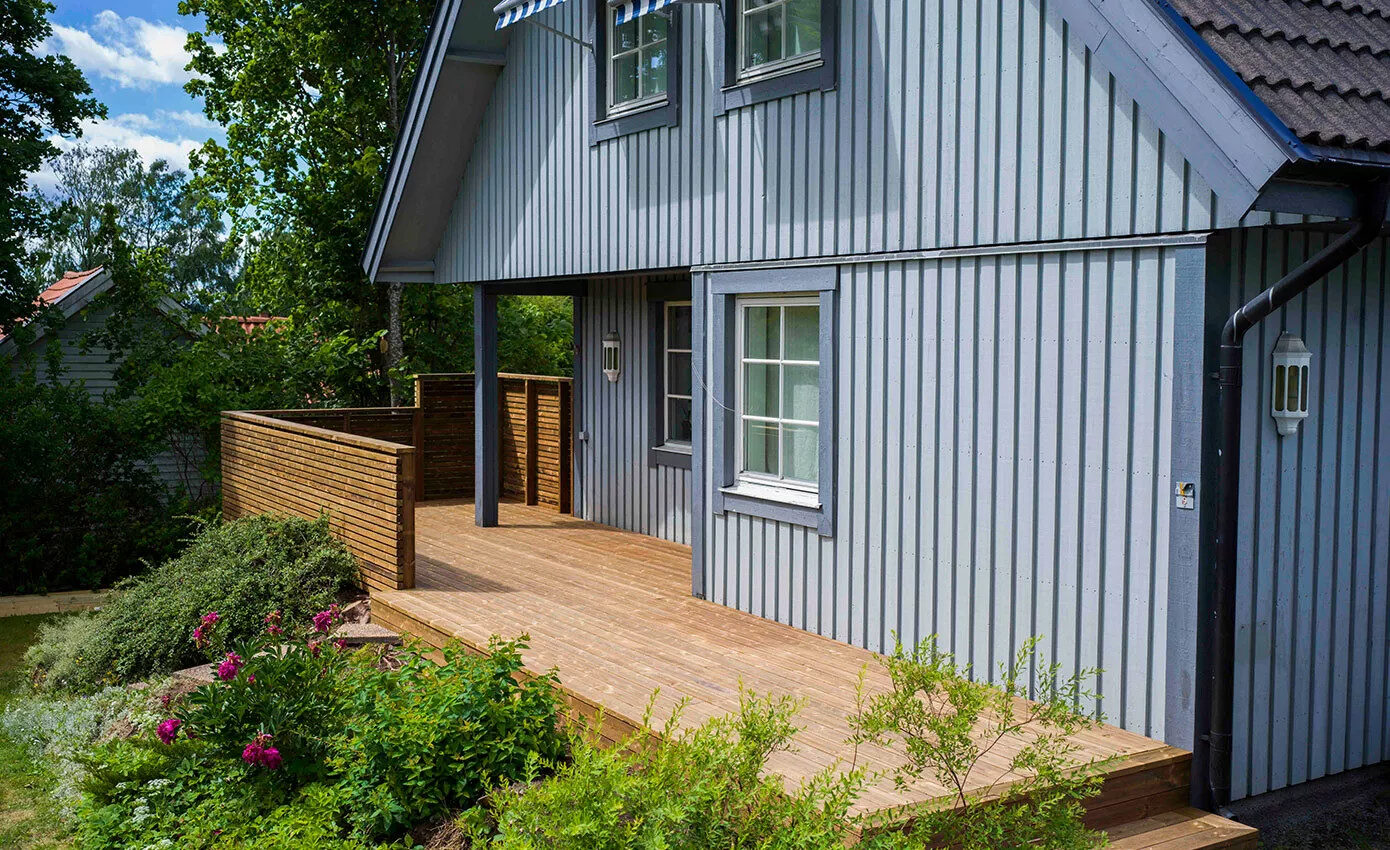
When a deck has to be notified
Under the current wording, a notification to the building authority is always required for single-storey minor structures with a built-up area of up to 50 m² and a height of up to 5 m (§ 2(4)(a) and § 18(3)), regardless of the distance from the plot boundary. The Act explicitly lists among them, for example, canopies and summer kitchens. You will therefore probably need a notification if the deck:
- has a roof, a canopy or a fixed pergola,
- stands on footings, posts or ground screws, or is raised,
- is larger than 40 m², so it can no longer be regarded as a paved area of up to 40 m².
A structure with a built-up area of more than 50 m² or higher than 5 m is not a minor structure – in that case, ask the authority whether you need a decision on the construction intention (§ 18(2)).
The notification must be accompanied by a construction design for notification and the binding opinions of the authorities concerned (§ 63(2)). If the notification is incomplete, the authority will ask you to complete it, and the time limit does not run in the meantime (§ 63(4)). The authority deals with a complete notification within 30 days by issuing a verification clause (§ 63(6)); if it does not verify the design of a minor structure or building alteration within this period, the clause is deemed to have been issued (§ 63(7)). If the structure could affect the rights of third parties, such as neighbours, the authority may notify you that you need a decision on the construction intention (§ 63(5)). Construction must start within three years of verification (§ 63(10)), and no occupancy approval is required for a notified structure (§ 66(1)).
A deck as part of the house
An extension is a horizontal enlargement of an existing structure that preserves its structural and operational unity (§ 5(3)). If the building authority assesses your deck as an extension of the house, it is an alteration of a completed structure (§ 5(1)), for which the Act, as a basic rule, requires a decision on the construction intention (§ 18(2)). In that case you will not manage without a designer. If you are planning the deck right next to the house or connected to its structure, ask the authority in advance how it will classify it.
What to keep in mind in every case
- The municipal land-use plan. Every structure must comply with the binding part of the land-use plan (§ 21(1)). It may restrict, for example, how much of the plot can be built on – check it at the municipal office.
- Heritage area. Construction work on a cultural monument and on a structure in a heritage area must be notified (§ 18(3)(f) and (g)). Independently of the Building Act, before a new structure or a modification of a plot in a heritage area, such as a heritage zone, you must obtain a decision from the regional monuments office on the planned modification of the property (§ 32(5) of Act No. 49/2002 Coll.).
- Distance from the boundary. A structure or ground modification closer than 2 m to the plot boundary must be notified (§ 18(3)(b)). A greater distance, however, does not spare you the notification if the deck is a single-storey minor structure – these must always be notified today. Slope the deck so that rainwater does not run onto the neighbouring plot.
- Approved amendment. On 15/9/2026 the National Council of the Slovak Republic approved an amendment to the Building Act; the changes to the Building Act are to apply from 1/1/2027. According to the approved wording, the limit for paved areas will increase from 40 to 50 m², minor structures will no longer have to be notified automatically but only in the cases under § 18(3), the 2 m rule from the boundary will also apply to building alterations, and in heritage areas only work that changes the external appearance of structures that are not cultural monuments will have to be notified. Until the amendment comes into force, the wording described above applies. Before submitting anything, check the current wording of the Act at slov-lex.sk.
Once the paperwork is clear, get building – you will find decking screws, joist fixings and decking boards at zrubko.sk.
The information reflects the Slovak Building Act No. 25/2025 Coll. as amended on 22 September 2026 and does not replace legal advice. Before starting work, check the requirements with the building authority of your municipality.