
Choosing wood cladding for a wall: what to watch out for?
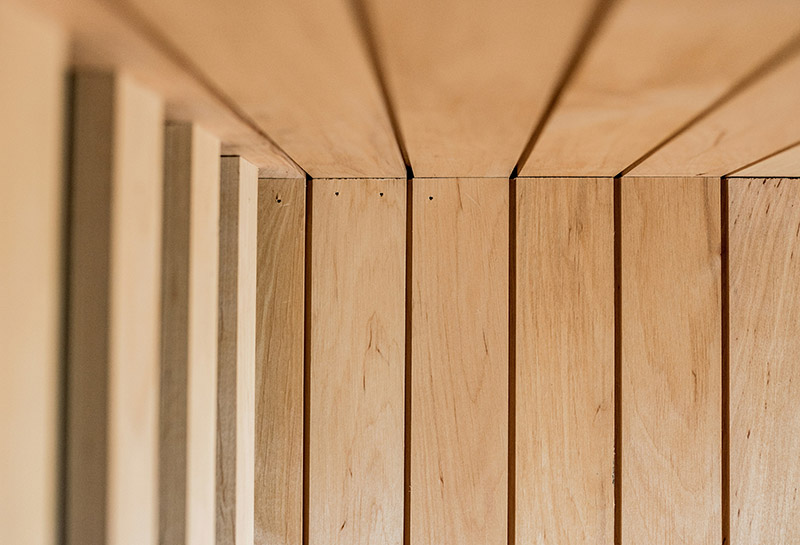
Perhaps you are at the stage of just preparing your new house, or, on the contrary, you are thinking about how to renovate your rooms so that you feel comfortable in them.
Whichever it is, if you are asking "what should I clad the wall with?", we definitely recommend wood. Wood is ideal and is the main element that does not age, it improves acoustics and brings the true warmth of home into the interior.
And what kind of wood? Wood cladding is a timeless choice, but its service life and final effect depend on the right preparation. That is why we have put together this article to guide you through choosing the right wood cladding. We will talk about the types of wood cladding and the most common mistakes you can come across when installing it.
@KATEGORIE: /en/wood-cladding/, 3
Why go for wood wall cladding?
Wood cladding has several advantages and functions that you will not get with other materials.
The first of them is thermal and acoustic insulation, as wood absorbs sound and can effectively maintain a pleasant indoor climate in every season.
What is more, you will feel in the aesthetics too that you have chosen the right wood. Wood cladding is a natural material in which every piece is unique and so together they create a visually interesting element.
You can therefore use wood panelling as a design element and a functional one at the same time.
What are the options for wood cladding: from Tatra profile cladding and tongue and groove to thermally modified wood
Do you want to use wood cladding indoors or outdoors? Your first choice will almost certainly be Tatra profile cladding, i.e. tongue and groove, which got its name from the way it joins together.
It is the most classic material with simple jointing, suitable above all for larger areas. Wood cladding panels, which create a three-dimensional effect thanks to the different thicknesses of their slats, are certainly on trend too.
@PRODUKTY: /en/tongue-and-groove-cladding-14-x-121-mm/, /tatransky-profil-soft-14x121/, /perodrazka-19x146-mm/
If you need wood cladding for the exterior, we definitely recommend thermally modified wood, which is heat-treated to withstand even the most varied weather conditions.
@KATEGORIE: /en/thermally-modified-wood/, 3
Choosing the right wall cladding? We at Zrubko will be happy to help you with that too. Just contact us or come in person to our shop.
How to choose the right wood species for wood cladding
Since wood cladding also differs depending on how it will be installed and what it will primarily be used for, it is good to know which wood species to choose from so that you pick the most suitable wood cladding for your needs.
- Spruce/Pine: Affordable softwood with a light shade, ideal for interiors.
- Larch: Harder, more resistant to moisture and pests.
- Oak / Exotic wood: Premium, hard and mechanically very durable wood, suitable even for walls under heavy wear.
When choosing the right wood species, it is also good to look at the currently valid classification into quality grades A, B, C. While grade A/AB is free of prominent knots and cracks, grade C carries the distinct characteristics of raw wood. That need not be a drawback at all and does not mean it is a less valuable grade, as it suits a more rustic or rougher style, for example.
What to watch out for when choosing and installing wood cladding
When choosing, definitely watch out for the moisture content of the wood – we have also prepared a separate article on this, as the moisture content of interior cladding must be in the range of 8 to 12 per cent.
In the long term, any higher moisture content means a risk of the boards later twisting or even cracking, so you would cause premature degradation of the material for no reason.
Likewise, installation often involves incorrect acclimatisation – the packs of cladding must lie in the room where they will be fitted for at least 48 hours before installation.
This is so that the wood adapts to the temperature and humidity of the room.
Wood cladding in the living room and bedroom: where to put it?
Wood on the wall does not have to cover the whole room. In most interiors it works best on a single surface that deliberately draws attention. How do you work with wood cladding in individual rooms?
Living room. Most often it is a feature wall behind the TV or behind the sofa. At the same time, the cladding dampens sound reflections, which you will appreciate especially in rooms with large glazed areas and hard flooring.
Bedroom. Cladding the wall behind the headboard creates a sense of security and also insulates against the cold from the external wall. If your bed stands against an outside wall, it is a practical solution. You get usefulness and aesthetics in one package.
Backlighting. LED strips can be recessed into the grooves between the profiles. This popular trend makes the joints between the individual profiles more visible. From our experience, with this solution it makes sense to reach for thicker profiles, for example tongue and groove cladding 19 × 146 mm. The reason? You have more room to recess the strips.
Do not forget that cladding needs a substructure. The battens are anchored to the wall and only then is the profile itself fitted onto them. This creates an air gap that lets the wood breathe and stops moisture from lingering behind the cladding. Well suited for the substructure are KVH structural timber beams, which are kiln-dried and therefore no longer move significantly after installation.
@KATEGORIE: /en/kvh-structural-timber-beams/, 3
For fixing, use ESSVE screws of premium Swedish quality, and do not forget our next tip: leave expansion gaps around the perimeter of the cladding. Fixing too rigidly without room for movement is the most common cause of cracked boards.
@PRODUKTY: /en/essve-wood-screw-essdrive-4-0-x-50-mm-fs-corrseal-pack-of-200/, /essve-sada-bitov-propack-20-ks-drziak-na-karabinu/, /essbox-kufor/
@KATEGORIE: /en/essve-fasteners/, 3
Finish and care of wood cladding
It is fitted. What next? Care and protection of the wood, of course. Wood coatings are not just about appearance; they are a functional layer that we do not recommend skipping. Coatings slow down the exchange of moisture between the wood and its surroundings and so dampen the seasonal movement of the material. In principle, you have three basic options:
Oil preserves the natural structure, the wood underneath it breathes and you can repair a damaged spot locally without a visible transition. For interiors, Hardwax Oil PREMIUM is a good choice; it penetrates deep and forms only a very thin film.
Lacquer forms a hard protective film, is easy to clean and resists abrasion, but is harder to renovate — a damaged area usually has to be sanded back completely. Reach for it where the cladding is touched often, for example in a hallway or a children's room. A suitable choice is the water-based Floor Lacquer PREMIUM.
Wax is something in between the two. Wax Woodstain, natural-based, offers good water resistance, so you can use it in a bathroom or kitchen too, where moisture lingers the most.
@PRODUKTY: /en/remmers-hardwax-oil-premium-natural/, /podlahovy-lak-premium/, /remmers-voskova-lazura/
@KATEGORIE: /en/wood-paints-and-oils/, 3
A little tip: watch out for UV radiation. Without a UV filter, light wood turns yellow or darker over time under the influence of the sun, even indoors, however illogical that may sound at first. It is most visible on walls opposite large windows, where the shadow of furniture shows after a while – you have surely seen this unwanted "effect" somewhere already. Outdoors it is even more pronounced, so we recommend solving it with UV+ Woodstain or HK Woodstain 3-in-1.
And one more thing that gets forgotten: treat the wood before installation. Once it is fitted, you can no longer reach the back of the board or the tongues and grooves. Treat the end cuts made when cutting to length on site with protective coating for end grain, because that is exactly where wood soaks up water fastest.
Wood cladding is a great investment – in health, aesthetics and comfort
Wood cladding is not just a temporary decoration, but a long-term investment in living comfort. It improves acoustics, insulates and gives a room a character that no other material can replace.
But it is not only about the price of the wood; that will not guarantee your satisfaction in the long run. What matters are three more things that we at Zrubko have presented in this article: correct acclimatisation of the wood, a quality substructure and a suitable finish. Neglecting any of them will show sooner than you might expect.
Before you buy, measure the moisture content of the substrate and go through the colour charts in person – the shades of wood and woodstains look different on a screen than on a wall. Drop in at our shop in Kysucké Nové Mesto, where we will advise you on your choice and also cut the wood to size. Or order coating samples.