
Wood oil for exterior use: how to choose and what will you need?
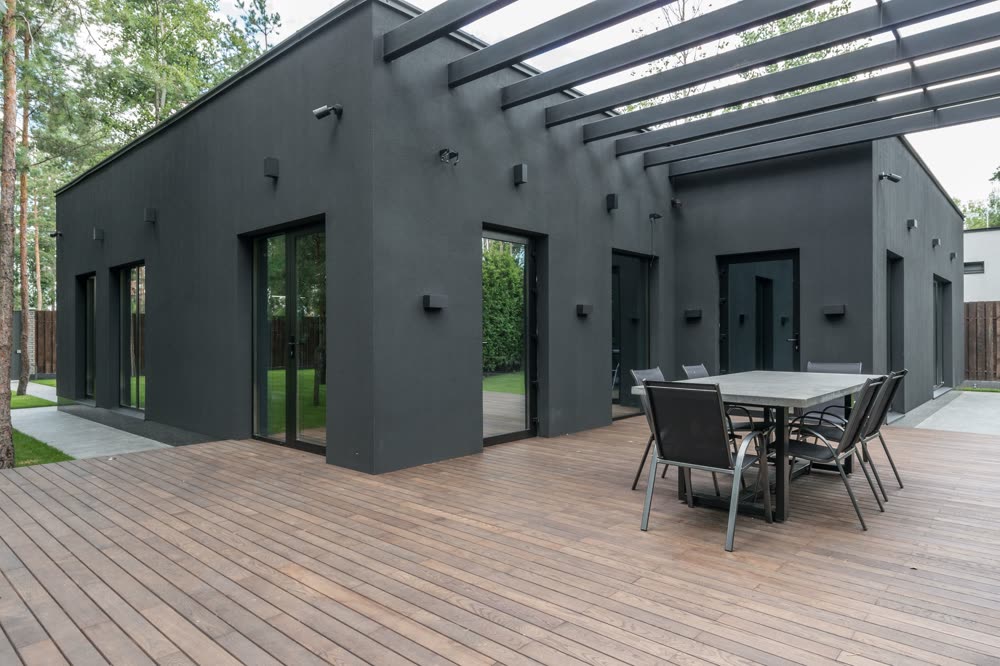
If you are deciding between thermally modified wood (thermo wood) and WPC, the price per square metre is not the only deciding factor. What matters is whether you want a wooden surface that can be repaired and that ages like wood, or a composite with a declared warranty and cleaning instead of oiling.
At Zrubko we sell wood, so it is natural that we recommend thermally modified wood. But we will also tell you where WPC wins, so that you can decide on the basis of facts.
One rule applies to the comparison: there is no single value for all WPC or for all thermally modified wood. The result depends on the specific product, colour, profile and installation.
What is thermally modified wood and what is WPC?
Thermally modified wood is ordinary wood that has undergone a controlled heat treatment in steam. Nothing is added to it; only its internal structure changes. The technical designations of the treatment classes are defined in the ThermoWood Handbook of the International ThermoWood Association. We have described this in more detail in the article What thermally modified wood is, how it is made and when it is worth using outdoors. You will find our entire range of thermally modified wood - decking boards, cladding and battens - in the Thermally modified wood category.
WPC is a composite of wood flour and plastic. The composition, profile shape (solid or hollow), colour and protective layer differ between manufacturers, so the properties of one WPC cannot automatically be assumed for another.
@KATEGORIE: /en/thermally-modified-wood/, 3
Which is more pleasant barefoot: thermally modified wood or WPC?
With WPC you need to expect considerable heating in direct sunlight, especially with dark boards. Manufacturers' technical documentation gives surface temperatures in the range of 50 to 65 °C and more, but the exact value depends on the colour and composition.
From the experience of people with WPC we know that in full sun dark WPC is hot underfoot, while under a roof it is not a problem. Wood also heats up in the sun. However, thanks to the treatment, heat transfer is slower than in standard wood
A study on heat-treated fir wood found exactly this slower heat transfer. For us, thermally modified wood is more pleasant, if only because it is a natural material, so when you step on it you really feel real wood. And nothing else.
Which material moves less with humidity and temperature?
Thermally modified wood has a lower equilibrium moisture content, so it swells and shrinks less than untreated wood. Wood will always be wood, so it will move to some extent. But even with WPC, which is not made of pure wood alone, you cannot avoid a slight change in dimensions.
WPC expands as the temperature rises. The movement can sometimes be around 0.3 to 0.5 %, which on a 4 m board with a large temperature difference can be as much as approximately 10 mm. That is why WPC requires consistent expansion gaps, and poor installation will take its toll.
What does a “maintenance-free” WPC deck mean in practice?
It is more accurate to say “no oiling”. This kind of WPC decking needs somewhat less care. Nevertheless, a WPC deck should ideally be cleaned at least twice a year, dirt should be removed from the gaps, and stains from grease, wine spilt during barbecues or mould should not be left to dry.
And how do you care for thermally modified wood? You have two options. You can let thermally modified wood turn grey naturally, which is only a surface change caused by UV radiation. Or you oil it if you want to keep its warm brown shade.
Oiling is therefore mainly a matter of appearance, but it also has its benefits for service life. You will find practical advice in the article 5 tips on how to care for thermally modified wood properly and oils in our Wood paints and oils category - for example Remmers TOP Decking Oil, which we keep in stock.
@KATEGORIE: /en/wood-paints-and-oils/, 3
What happens if one board is damaged?
For us, thermally modified wood wins here - you can replace a damaged board, and with minor local damage it may be possible to sand the surface, depending on the profile, although the shade may change slightly.
For WPC with a protective layer, manufacturers often do not recommend sanding. Replacing a board is possible, but it depends on whether boards of the same series and colour will still be available in a few years.
How much do WPC and thermally modified wood cost in Slovakia?
The price per m² alone does not tell you how much a new deck will cost you, whether it is made of thermally modified wood or WPC. The difference between profiles and product lines is large for both WPC and thermally modified wood.
With thermally modified wood, always check that it is a genuine decking board and not a cladding profile, and with any material, allow for the whole build-up: substructure, screws, shipping, waste, installation and maintenance (oiling for wood, cleaning for WPC).
@KATEGORIE: /en/decking-boards/, 3
When does WPC objectively win?
- You do not want to oil - WPC does not need oiling, although it does need cleaning.
- You want a warranty with a fixed term - manufacturers state one for selected product lines, subject to their own conditions.
- You need a documented anti-slip classification - for example by a swimming pool. Some WPC product lines have a declared class R11 and class C for bare feet, but you need to request it for the specific product.
- You prefer a uniform colour - but watch out for possible colour changes, which even the manufacturers themselves admit.
When do we recommend thermally modified wood?
In our view, thermally modified wood is the first choice if you want a deck by your house or cottage that looks and feels like wood. It makes sense especially when:
- you want a natural wooden surface and accept a patina or occasional oiling,
- repairability matters to you - you replace a board or repair it locally,
- you want more stable wood than ordinary untreated material,
- you do not want any plastic content in a material you will have underfoot for years.
The weaknesses of thermally modified wood are also clear. Heat treatment reduces strength, so a decking board is not a load-bearing element and the substructure must be designed according to structural calculations. Without treatment the surface turns grey and can crack locally. Correct installation is important: ventilation, drainage, height of the boards above the ground (manufacturers recommend at least 100 mm), joist spacing (typically up to 400 mm) and suitable screws.
For the substructure we also use KVH structural timber beams, which are commonly combined with decking boards and thermally modified wood. For fixing the boards themselves we recommend ESSVE stainless steel fasteners and accessories (for example Torx bits for a decking screwdriver) - we will select them for you to suit the board thickness.
@KATEGORIE: /en/kvh-structural-timber-beams/, 3 @PRODUKTY: /en/essve-torx-bits-high-quality/
If you are dealing with a facade as well as a deck, we also offer thermally modified wood as Thermo Rhombus double cladding 26 x 142 mm or Thermo cladding UTS 20 x 117 mm - the same material, the same care, a uniform look on the deck and on the wall.
@PRODUKTY: /en/thermo-rhombus-double-cladding-26-x-142-mm/, /termo-obklad-uts-20-x-117-mm/
How to decide before you choose - ask yourself these questions
- Do you walk on the deck barefoot and is it in direct sunlight?
- Will it be by a swimming pool?
- Do you want to oil it, or will you accept a grey patina?
- Can you manage drainage and ventilation of the substructure?
- Do you know the joist spacing and type of screws according to the manufacturer's instructions?
- Will a replacement board be available in a few years?
Frequently asked questions
Is thermally modified wood or WPC better?
There is no universal winner. Thermally modified wood suits a natural look, repairability and more stable wood. WPC suits you if you do not want to oil and you choose a product with a documented warranty and anti-slip test.
Is a WPC deck hot in the sun?
It can be, especially with dark boards in direct sunlight. The exact temperature depends on the colour, profile, wind and shading.
Does thermally modified wood turn grey?
Yes, without a pigmented treatment it can gradually lose its colour and turn grey due to UV radiation. This is a surface change. Oiling preserves or restores the colour.
Does a WPC deck need cleaning?
Yes. Manufacturers recommend removing dirt from the gaps and washing the deck with water at least twice a year, and using special procedures for stains and mould.
What joist spacing does a deck need?
It is not the same for all products. For wooden decking boards it is usually at most 400 mm; for WPC, depending on the system, approximately 400 to 450 mm is given. The installation guide for the specific board is decisive.
Is WPC more eco-friendly than wood?
This cannot be claimed in general. You need to compare environmental product declarations (EPD) with the same system boundaries, service life and end of life.
Can a damaged board be replaced?
Yes, for both materials, if a replacement board is available. With thermally modified wood it can also be worked locally, depending on the profile.
Would you like to see thermally modified wood in person?
You will find thermally modified wood decking boards in the Thermally modified wood category on Zrubko.sk. At our shop in Kysucké Nové Mesto you can look at and touch the samples, and even try them out in the sun. We will help you choose the profile, screws and substructure to suit your deck.
@KATEGORIE: /en/thermally-modified-wood/, 3