
Guide: a timber deck in a herringbone pattern
Build a timber deck in a herringbone pattern
A timber deck is an excellent choice for anyone dreaming of an elegant outdoor space. The herringbone pattern, which has graced interiors for centuries, has successfully moved onto decks, tables and kitchen islands too. A herringbone deck gives a space a unique, luxurious character. However, this kind of pattern requires more precision than ordinary board laying. So how do you build an attractive deck in this style? Here is our guide!

How do you plan and install a herringbone deck?
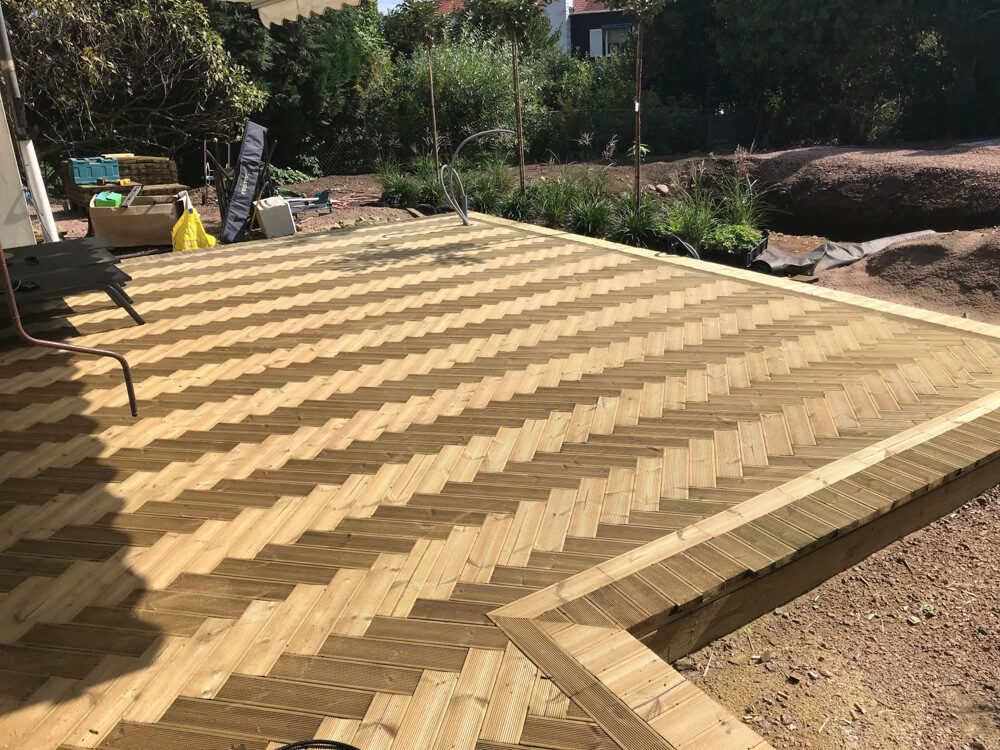
One of the experts who have taken on building a herringbone deck is carpenter Andreas Nikolaisen. His 60 m² project in Fredrikstad, Norway, includes a 20 m² section of deck designed in this classic pattern and installed with a hidden fixing system for decking boards – the Hidden Decking System (HDS). If you want your deck to look exceptional too, below you will find some advice to help you achieve a perfect result.
1. Divide the deck into sections
If you are planning a larger deck, a herringbone pattern over the whole area can look too busy. For a subtler, more balanced effect, divide the deck into smaller sections and use the herringbone pattern in only some of them. The deck will look elegant and the work will take you less time.
2. Dry-lay the boards first
Before you fix the boards permanently, lay them out dry and check that the pattern matches what you have in mind. This kind of “test run” lets you adjust the layout and make small corrections before the actual installation – saving you time and effort.
3. Cut in batches and sand the board ends
To keep the work flowing, it is best to cut the boards to the required length in batches. Sanding the board ends to remove sharp edges is also an important step. Your deck will then be attractive and smooth.
4. Hidden fixing of the boards – a guarantee of elegance
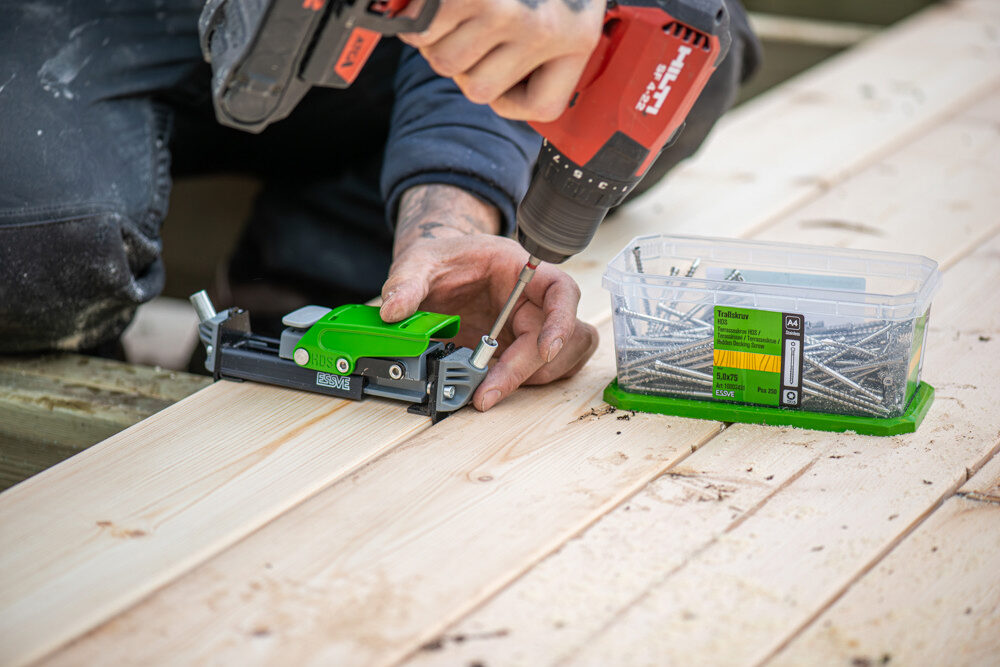
If you are going to the trouble of a herringbone deck, it is worth thinking about details too, such as hidden fixing of the decking boards. With hidden fixing the screws cannot be seen and the deck looks even more elegant. In the Hidden Decking System (HDS), the screws are driven at an angle from the side of the board, so the surface stays smooth, without visible fasteners.
Photos from the building of Andreas's deck:


Designing a herringbone deck
Which wood should you choose for a timber deck?
When you decide to build a timber deck, take time to choose suitable wood. Different types of wood change their properties over time and require different care. Think about which surface treatment of the wood will best match the rest of the space and whether the wood will need special maintenance in future. Here you will find our guide to choosing wood.
Board width and length – how do they affect the result?
A herringbone pattern on a deck depends to a large extent on the width and length of the boards. Following Andreas's advice, it is a good idea to lay out several rows of boards before fixing them to the structure and see how they work together. This is the best way to check whether the chosen board size suits the overall design.
A pattern within a pattern
For an even more considered effect, you can combine wood colours – choosing different shades or different surface treatments.

Tips for a herringbone deck
How do you install the deck joists correctly?
To give the decking boards in a herringbone pattern enough support, use double joists when building the deck. The photo shows how Andreas built his structure.
As double joists mean a little more work, we recommend building the structure with ET-T or WAF construction screws. Both are excellent, easy to install without connectors and do not require pre-drilling.
With a herringbone deck it is more important than usual that the distances between the joists are the same across the whole structure. The distance between the centres of two joists is called the centre-to-centre spacing (C-C).
Measure and keep the properties of wood in mind
In each row of the herringbone pattern, measure and mark the centre of each joist – this makes it easier to achieve a straight pattern. When laying boards in a herringbone pattern, also remember that wood shrinks and swells with moisture and changing weather.
- Design the deck so that two straight surfaces never meet directly.
- For standard installation, it is recommended to keep the spacing between boards (the distance “from edge to edge”) in line with the recommendations of the organisation Svenskt Trä. With a herringbone pattern this principle cannot always be followed. What matters is that the decking boards never lie tight against each other – always leave a little space so that the wood can swell. With ESSVE decking spacers you can easily keep the same gap between the boards (3, 4, 5 or 6 mm).

Installation products
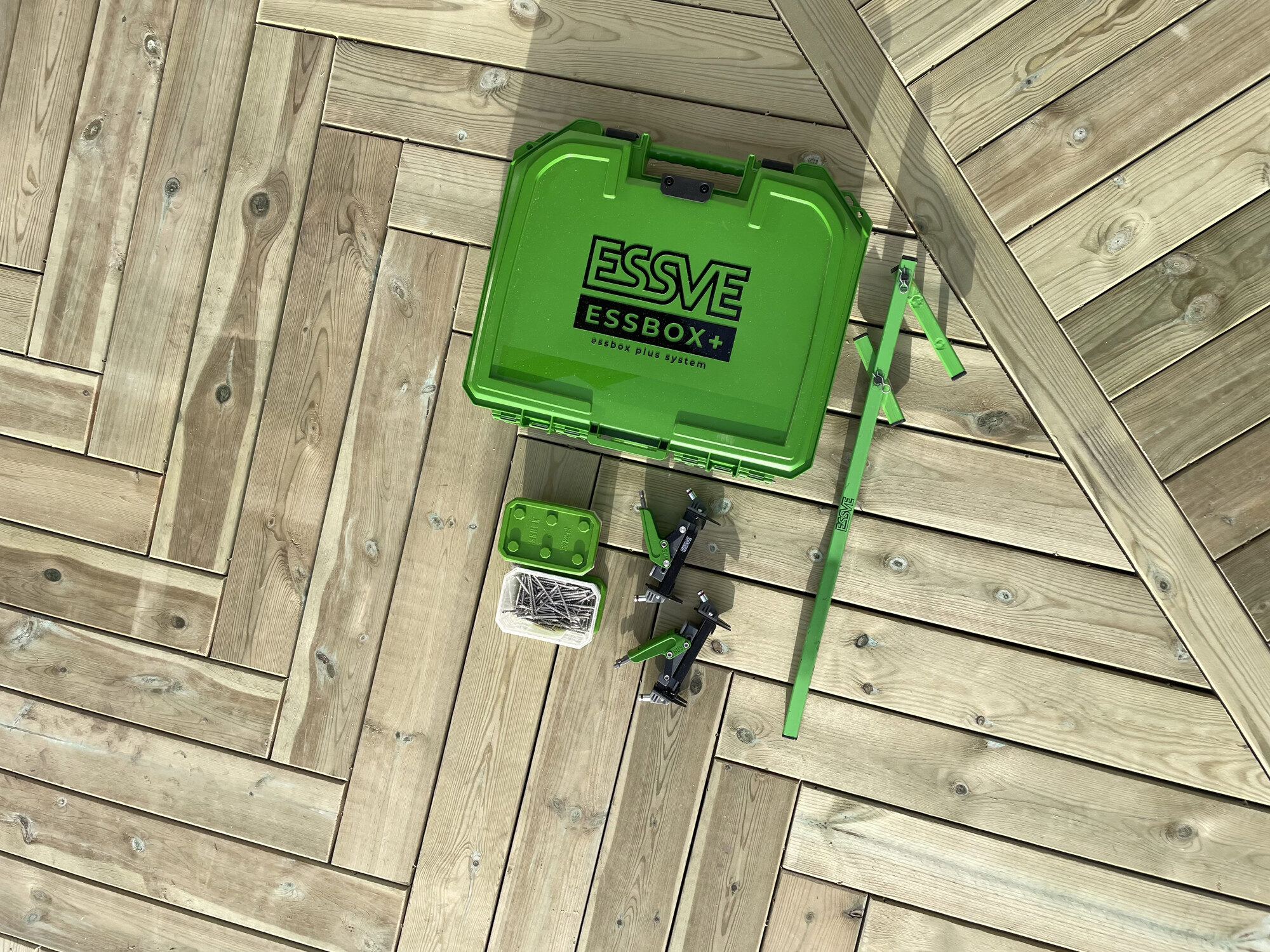
Carpenter Andreas chose to lay the decking boards in a herringbone pattern using the HDS hidden fixing system. Decking boards can, of course, also be installed with conventional screws.
 ESSVE Decking screw HDS Pro with drill point, hidden fixing 4.8 x 60 mm A4, pack of 250
 ESSVE Decking screw HDS Pro with drill point, hidden fixing 5.0 x 75 mm A2, pack of 250
 ESSVE HDS Pro screwdriver for decking boards
 ESSVE Tool bit TX15 X100 Extended /2/10
 ESSVE Decking screw HDS 4.8 x 60 mm A2, pack of 250
 ESSVE Decking screw HDS, hidden fixing 4.8 x 60 mm A4, pack of 250
 ESSVE Distance Tool spacer for decks
Recommended articles
How to lay decking boards without visible screws
Hide the screws during installation and give your deck an elegant look
Choose the right wood for your deck
Appearance and maintenance are two important factors when choosing wood. We look at common types of wood and what to consider.