
FAQ: your most common questions about building a deck
FAQ: your most common questions about building a deck
Which wood should I choose? How long should the screws be? Do I need to pre-drill before screwing? We answer these and many other questions about building a deck below!
Does building a deck require a building permit?
The Building Act No. 25/2025 Coll. does not expressly regulate decks. A simple ground-level deck of up to 40 m² without a roof may be built without either a notification or a permit only if the building authority assesses it as a paved area (an external landscaping feature). A deck with a roof or pergola, one on footings or ground screws, or one larger than 40 m² must, as a single-storey minor structure of up to 50 m², usually be notified to the building authority. Above 50 m² it is no longer a minor structure, and a deck assessed as an extension to the house requires a decision on the building intention. From 1 January 2027 these rules change under an approved amendment. The binding decision rests with the building authority of your municipality.
More information: Decks and the Building Act
How far from the property boundary can a deck stand?
The Building Act does not set a fixed minimum distance for a deck. However, a structure or landscaping closer than 2 m to the property boundary must be notified to the building authority (Section 18(3)(b) of Act No. 25/2025 Coll.); a deck that is a single-storey minor structure must be notified even at a greater distance. The municipal zoning plan may impose stricter requirements. Plan the fall of the deck so that rainwater does not run onto the neighbouring property.
More information: Decks and the Building Act
How do you choose the right wood for a deck?
The choice depends on your budget and the expected service life. Siberian larch is hard and naturally durable, treated pine is a good-value option and exotic wood (e.g. bangkirai) offers the highest durability. Remember that thermally modified wood (ThermoWood) requires a special approach during installation.
Comparison of wood species: Choosing wood for a deck
What is the best foundation for a deck?
The choice depends on the load-bearing capacity of the soil. On stable ground, concrete blocks are sufficient; on less stable soils (sand, clay), concrete footings cast on site with anchors or adjustable supports are recommended.
More information: Guide to deck foundations
How do you correctly fix the deck structure to the facade of the building?
The installation method depends on the wall material. For concrete, mechanical anchors or EUS concrete screws are used. For lightweight concrete use HL screws, and for a wooden facade WAF or HEX construction screws. Remember that render and insulation are not load-bearing layers!
Step-by-step guide: Fixing to the facade
What centre distance should the joists have?
The standard centre distance is 60 cm, but with thin boards (under 25 mm) or composite boards it needs to be reduced to 40 cm so that the deck floor does not sag.
Construction details: Substructure and centre distances
How do you protect the deck structure from moisture?
All components that touch the ground or the foundation must be separated by insulation (e.g. bitumen or rubber pads). It is also worth sticking protective tape to the top face of the joists.
More information: The 7 most common problems when building a deck
When do I have to use stainless steel screws (A2 or A4)?
Stainless steel is essential in three cases:
- Location: Coastal areas, close to pools (A4 steel).
- Type of wood: Exotic wood, oak and thermally modified wood (ThermoWood) – they contain tannins and acids that damage ordinary steel.
- Structure: Large decks that move and create high stresses (stainless steel is more flexible – it does not snap).
What do the corrosion resistance classes (e.g. C4, C5) mean?
The class determines how resistant the surface treatment is to rust. C4 (e.g. the CorrSeal surface treatment) is suitable for normal outdoor conditions. C5 is the highest protection, required in aggressive environments (e.g. ports, industrial sites).
What screw length should I choose for a decking board?
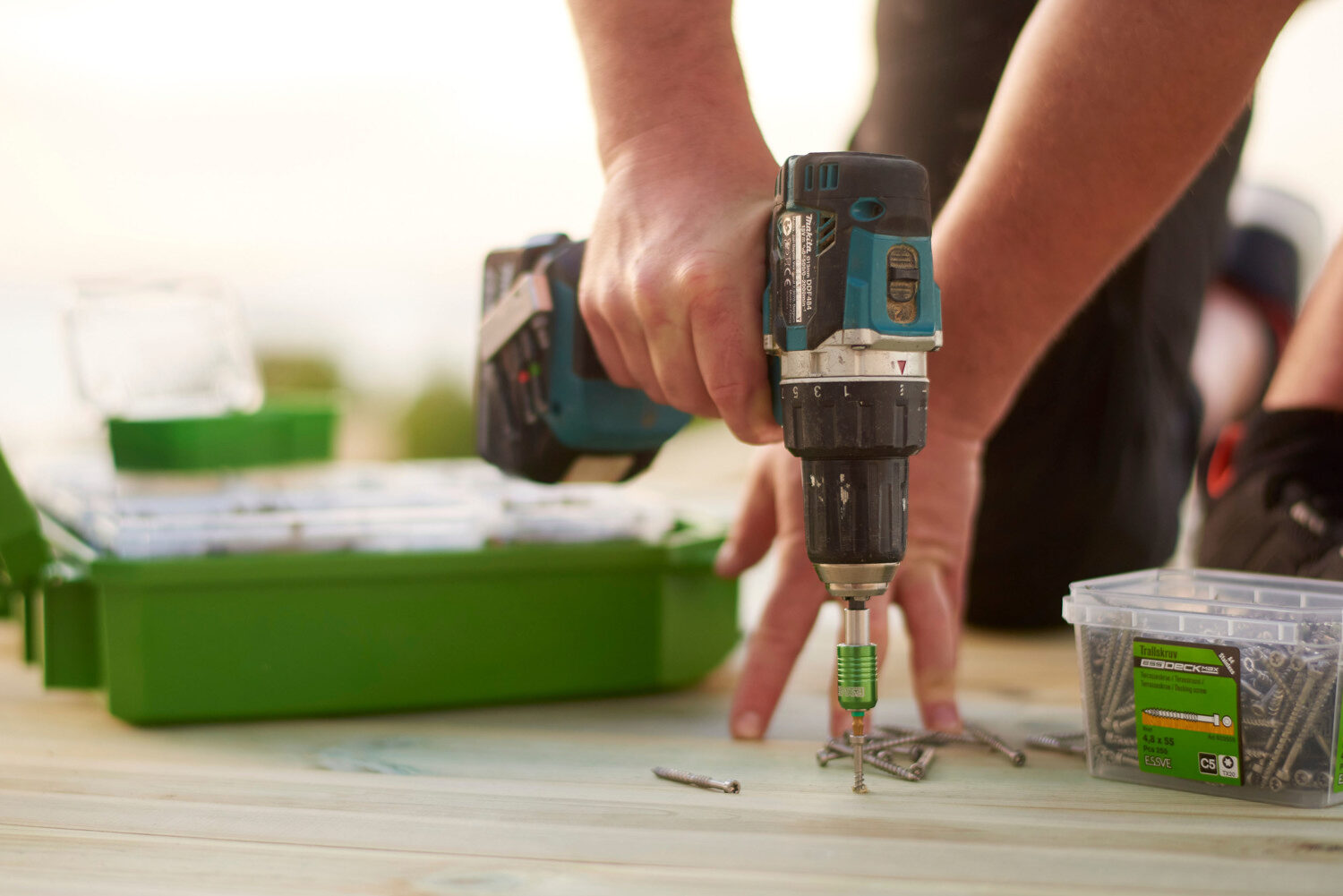
The rule is simple: the screw should be at least twice as long as the thickness of the board being fixed. For a 28 mm thick board, a screw 55 – 60 mm long is standard.
Selection table: Choosing the screw length
Visible or hidden fixing (HDS) – which to choose?
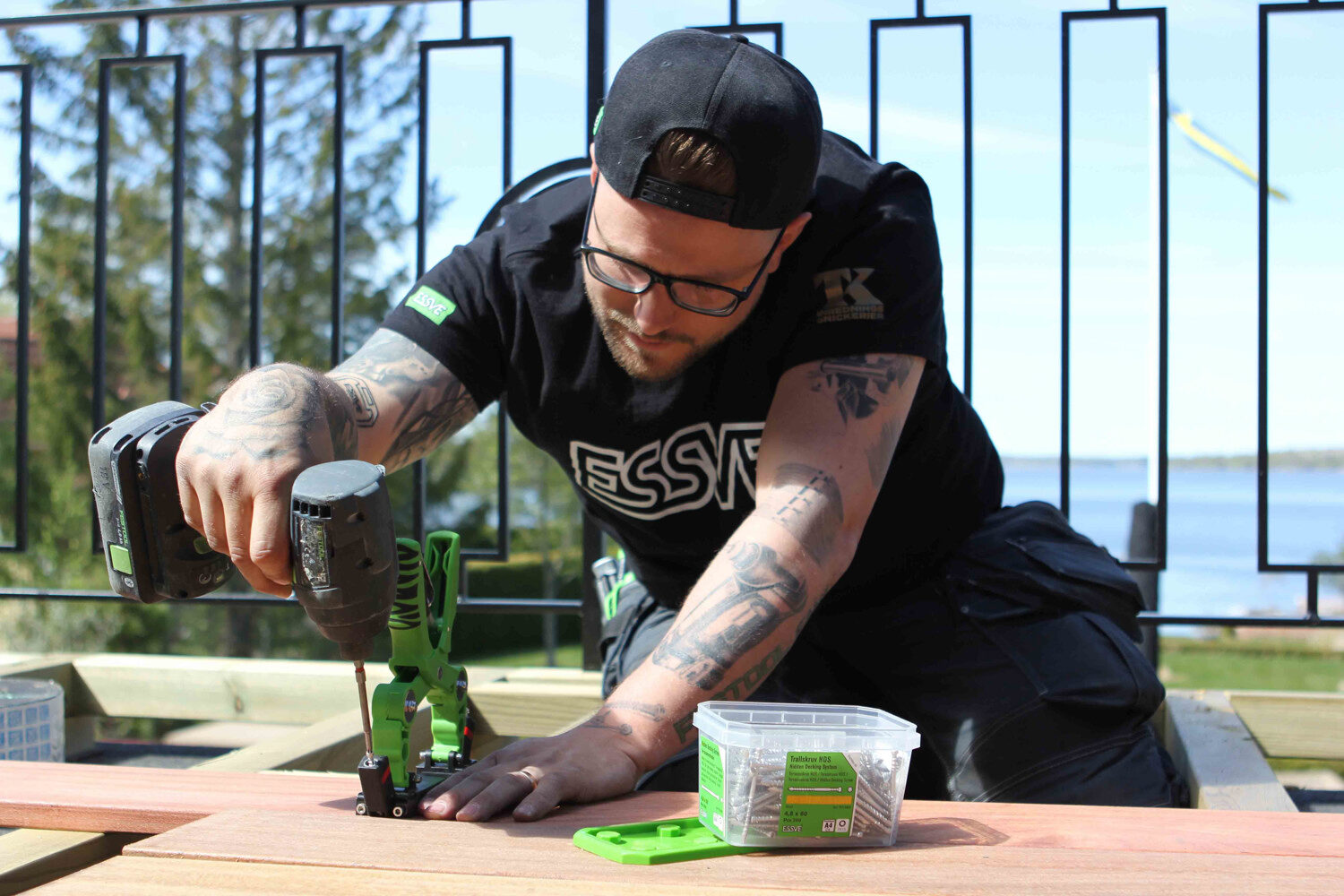
Visible fixing is faster and cheaper. The ESSVE HDS hidden fixing system ensures a perfectly smooth surface without visible screw heads, which improves both the look and the service life (water does not get into holes in the board surface).
Comparison of systems: Visible or hidden fixing?
What spacing should be left between boards?
The expansion gap is crucial because wood swells when damp. The spacing depends on the width of the board and the type of wood (usually 3 to 6 mm). A missing expansion gap is the most common mistake that leads to damage to the deck.
Important tips: Remember the spacing
Do I need to pre-drill before screwing?
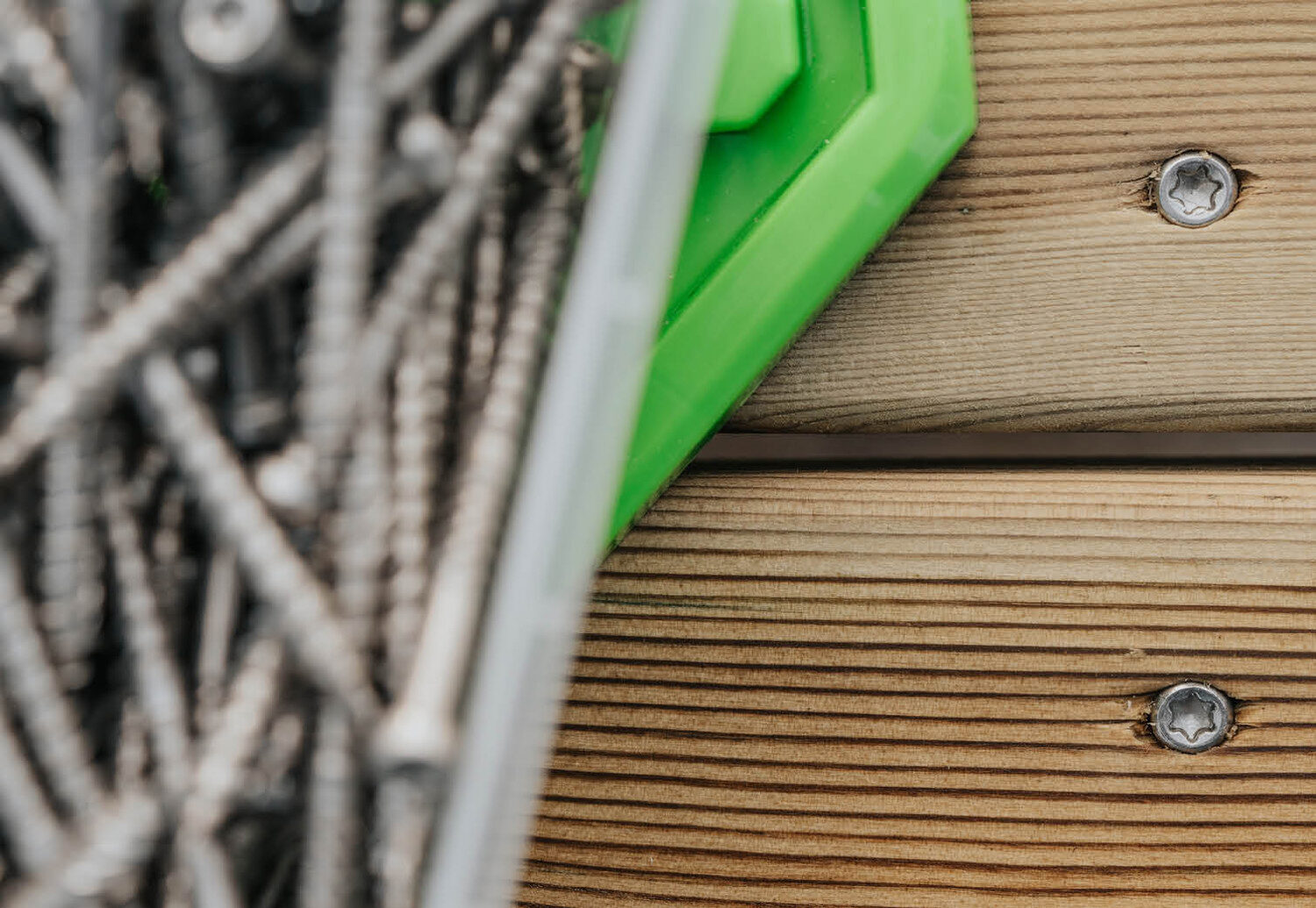
ESSVE decking screws have milling ribs that reduce the risk of the wood splitting. However, pre-drilling is always recommended when fixing close to the edge of the board or into hard exotic wood.
How should boards be laid – can they be laid “upside down”?
It is recommended to install the board heart side up. When the wood starts to move, the board becomes slightly convex, so water runs off its surface more easily.
If you are not sure how to recognise the heart side, look at the growth rings on the end of the board – they should form a smile.
More information: Correct installation of boards
Is installing boards in a herringbone pattern more demanding?
It certainly takes more time and requires good planning: the joists must be laid closer together and in two rows, and many boards will need to be cut precisely at an angle of 45°. The visual effect, however, is very exclusive.
More information: How to build a herringbone deck?
How do you look after a finished deck?
At least once a year (ideally in spring), wash the deck and check the condition of the surface treatment. Oiling preserves the colour of the wood and protects it from UV radiation.
Maintenance guide: How to look after a deck
Can a deck be built in autumn or winter?
Yes, if the weather allows (if the ground is not frozen deep down and earthworks are possible). In autumn, material prices are often lower, contractors have more time and you can enjoy your deck from the very first warm days of spring.
Article: Building a deck in autumn – why not?
Can just the damaged boards be replaced without dismantling the whole deck?
Yes, if the substructure (joists) is in good condition, you can unscrew the old boards and install new ones. It is an eco-friendly and economical way to renew a deck.
More information: Replacing decking boards
Best-selling deck products
 ESSVE Decking screw HDS Pro with drill point, hidden fixing 5.0 x 75 mm A2, pack of 250
 ESSVE Decking screw HDS Pro with drill point, hidden fixing 4.8 x 60 mm A4, pack of 250
 ESSVE Decking screw ESSDECK MAX 4.8 x 55 mm CorrSeal, pack of 250
 ESSVE Decking screw ESSDECK MAX 4.8 x 55 mm A2, pack of 250
 ESSVE Decking screw ESSDECK MAX 4.8 x 55 mm A4, pack of 250
Useful installation tools


Want to find out even more?
The information in this guide is for guidance only. Follow the manufacturer's technical data sheet and the applicable standards; if in doubt, contact us.
The information reflects the Slovak Building Act No. 25/2025 Coll. as amended on 22 September 2026 and does not replace legal advice. Before starting work, check the requirements with the building authority of your municipality.